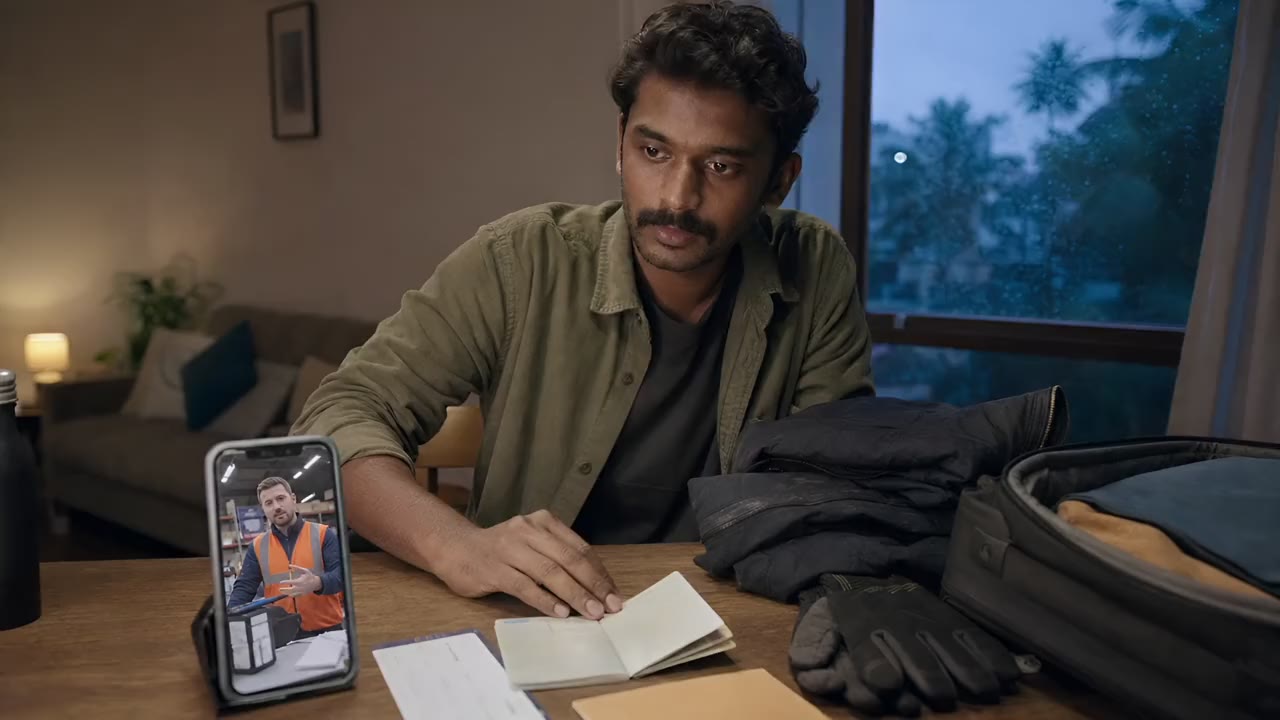
He'll learn the rules while still at home: the route, the housing, the shift — and the red button he'll one day press. A mini-series the employee doesn't watch. He lives it.
A safety manual is a PDF nobody opened. Meanwhile a person lands in a foreign country — a different language, a different cold, an unfamiliar plant floor — and learns everything on their first day, by trial and error. This format flips the order: the employee lives their first day as a short series while still at home, before the flight. Below is a working example: the fictional network MERIDA LOGISTICS and its new hire, Ravi.
An instruction is forgotten within the hour. A scene where you stopped the conveyor yourself and did everything right — that stays. The employee arrives already knowing the route from the airport, their room, the supervisor's face, and where the red button is.
The foreign airport stops being a trial: he's already seen the route, the documents, and the coordinator's face at home.
The housing, the roommates, the house rules — no surprises on the first evening, no panic of "where have I ended up."
How to get in, where to change, who to report to — the employee walks it with confidence, not guesswork.
The safety rule shown in a scene, not a paragraph: he saw why the button matters.
The incident rehearsed before it ever happened for real. Day one isn't adaptation — it's work.
A rule lived through a story comes back on the floor. The person already made this decision — in the video, before it was needed for real.
The route, housing, badge, supervisor and rules are all covered before the flight. The company doesn't spend the first week explaining the basics.
Name, role, department, country, language, real offices and supervisors. A swarm of personal series instead of one generic presentation.
Real facilities and rules: the plant floor, warehouse, dormitory, uniform, safety procedures, shift supervisors. Everything the employee will see on day one.
Dramaturgy from the evening at home to the end of the first shift: the route, housing, access, briefing, a typical incident and the right decision.
The engine assembles a series for each person: name, role, country, language. The hero's face and voice hold across the whole series — it's the same person, not a set of clips.
The link reaches the employee at home — a week before the flight. The company sees who finished watching and where they stopped.
From an evening at home in India to the end of the first shift: the route, housing, badge, rule, incident and decision. One MERIDA LOGISTICS series — and the person shows up as one of the team, not lost.
Build onboarding for your company Other formats